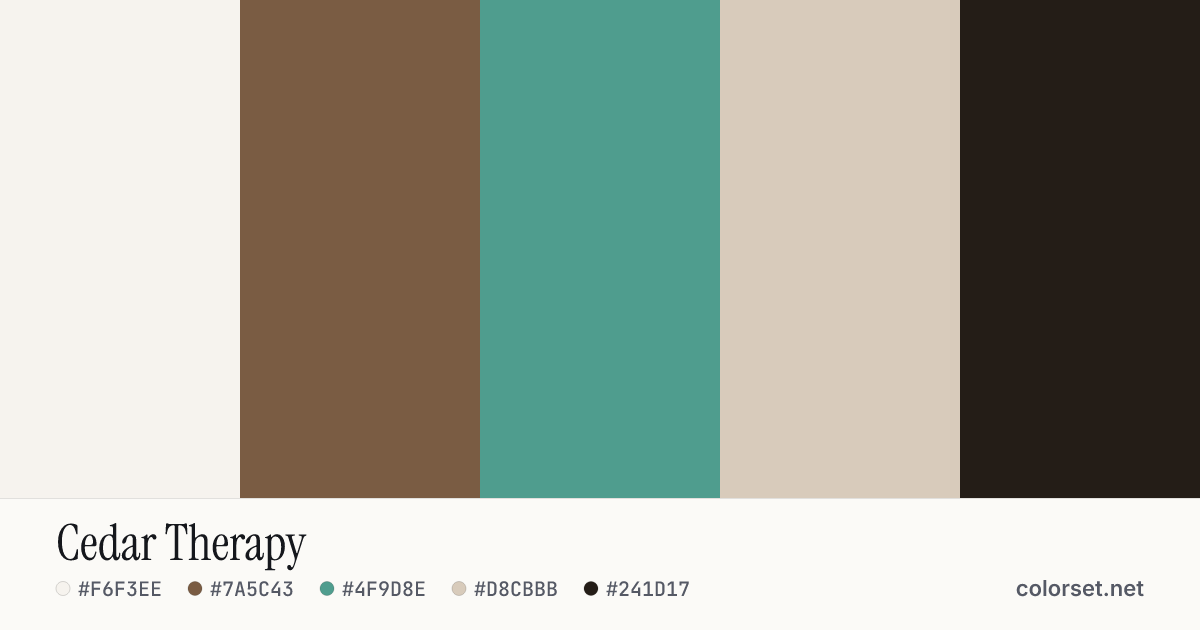
PreviewingGo to this paletteOpen in generator
Code
/* Cedar Therapy — colorset.net */
:root {
  --color-1: #F6F3EE;
  --color-2: #7A5C43;
  --color-3: #4F9D8E;
  --color-4: #D8CBBB;
  --color-5: #241D17;

  --color-bg: #F6F3EE;
  --color-surface: #FCFAF7;
  --color-border: #DFDAD2;
  --color-text: #241D17;
  --color-muted: #766E66;
  --color-primary: #4C9A8B;
  --color-on-primary: #241D17;
  --color-accent: #7A5C43;
  --color-on-accent: #FFFFFF;
}

@media (prefers-color-scheme: dark) {
  :root {
    --color-bg: #241D17;
    --color-surface: #2F2822;
    --color-border: #473D34;
    --color-text: #F6F3EE;
    --color-muted: #94918D;
    --color-primary: #4F9D8E;
    --color-on-primary: #241D17;
    --color-accent: #8C6D54;
    --color-on-accent: #FFFFFF;
  }
}
Color values
| Color | HEX | RGB | HSL | OKLCH |
|---|---|---|---|---|
| 1 | ||||
| 2 | ||||
| 3 | ||||
| 4 | ||||
| 5 |
Roles & contrast
Original colors are kept; roles are adjusted only when needed for contrast.
| Role | Light mode | Dark mode |
|---|---|---|
| Background | from palette · color 1 | from palette · color 5 |
| Surface | derived | derived |
| Border | derived | derived |
| Text | from palette · color 5 | from palette · color 1 |
| Muted text | derived | derived |
| Primary | adjusted for contrast · from #4F9D8E | from palette · color 3 |
| On primary | derived | derived |
| Accent | from palette · color 2 | adjusted for contrast · from #7A5C43 |
| On accent | derived | derived |
Contrast
| Pair | Sample | Ratio | WCAG |
|---|---|---|---|
| Text on background | 15.02:1 | AAA pass 4.5:1 | |
| Text on surface | 15.96:1 | AAA pass 4.5:1 | |
| Muted text on background | 4.53:1 | AA pass 4.5:1 | |
| Label on primary | 4.99:1 | AA pass 4.5:1 | |
| Label on accent | 6.11:1 | AA pass 4.5:1 | |
| Primary on background | 3.01:1 | AA Large pass 3:1 | |
| Accent on background | 5.52:1 | AA pass 3:1 |
| Pair | Sample | Ratio | WCAG |
|---|---|---|---|
| Text on background | 15.02:1 | AAA pass 4.5:1 | |
| Text on surface | 13.11:1 | AAA pass 4.5:1 | |
| Muted text on background | 5.30:1 | AA pass 4.5:1 | |
| Label on primary | 5.18:1 | AA pass 4.5:1 | |
| Label on accent | 4.74:1 | AA pass 4.5:1 | |
| Primary on background | 5.18:1 | AA pass 3:1 | |
| Accent on background | 3.51:1 | AA Large pass 3:1 |
Every color on every color
Rows are backgrounds and columns are text colors, using the actual palette colors. Ratios: AAA 7:1, AA 4.5:1, AA large text 3:1.
| Background / Text | #F6F3EE (Text 1) | #7A5C43 (Text 2) | #4F9D8E (Text 3) | #D8CBBB (Text 4) | #241D17 (Text 5) |
|---|---|---|---|---|---|
| #F6F3EE | Same color | 5.52AA | 2.90— | 1.44— | 15.02AAA |
| #7A5C43 | 5.52AA | Same color | 1.90— | 3.83AA Large | 2.72— |
| #4F9D8E | 2.90— | 1.90— | Same color | 2.01— | 5.18AA |
| #D8CBBB | 1.44— | 3.83AA Large | 2.01— | Same color | 10.43AAA |
| #241D17 | 15.02AAA | 2.72— | 5.18AA | 10.43AAA | Same color |
Shades
Shades and tints (50–950)
#F6F3EE#7A5C43#4F9D8E#D8CBBB#241D17